
8-Week Program (16 Instructional Hours)
An evidence-based curriculum grounded in CBT, Criminal Thinking Error restructuring, and the Risk-Need-Responsivity (RNR) framework, delivered over 8 structured weeks.
8 Weeks
16 instructional hours
$149
- 8 structured weekly modules
- Knowledge checks & reflections
- Weekly Behavioral Risk tracking
- Court-verifiable certificate
- Scenario-based exercises
OM Worldwide's court-ordered Theft Prevention class is a 100% online, self-paced course for adults completing a theft, shoplifting, petty theft, retail theft, larceny, probation, or diversion-program requirement. Final acceptance is determined by your requesting court, probation officer, county, diversion program, or agency, so confirm what your written requirement specifies before enrolling. The program runs 8 weeks and counts as 16 instructional hours for $149, and OM Worldwide issues a court-ready certificate of completion after full course completion. If the certificate page is live and general to OM certificates, link to it here. If not, link to the certificate section on this page.
What You’ll Learn Each Week
A progressive, skills-based curriculum grounded in CBT, Criminal Thinking Error restructuring, and the Risk-Need-Responsivity (RNR) framework.
Week 1
Understanding Theft Behavior and Personal Accountability
The decision process behind theft behavior, thinking errors, and developing personal responsibility.
Week 2
Criminal Thinking Errors and Cognitive Restructuring
Identifying distorted thinking patterns and learning to replace them with responsible decision-making.
Week 3
Decision-Making and Impulse Control
Understanding the behavior chain, managing urges, and interrupting high-risk situations.
Week 4
Victim Awareness and Moral Responsibility
Recognizing the impact of theft, developing empathy, and strengthening accountability.
Week 5
Financial Stress and Lifestyle Risk Factors
How financial pressure, instability, and poor planning increase risk, and building lawful alternatives.
Week 6
Peer Influence and Environmental Risk
Understanding how people, places, and situations affect behavior and learning how to reduce risk exposure.
Week 7
Values, Identity, and Long-Term Behavior Change
Building prosocial values, strengthening integrity, and committing to lawful choices.
Week 8
Relapse Prevention and Future Planning
Identifying warning signs, managing high-risk situations, and creating a long-term accountability plan.
Course Content Preview
Theft Prevention Preview · Week 1
Understanding Theft Behavior & Personal Accountability
Behavioral Definition · Thinking Errors · Decision Chain & Risk Meter
Unit 1 — Theft Prevention Preview
The Behavioral Definition of Theft
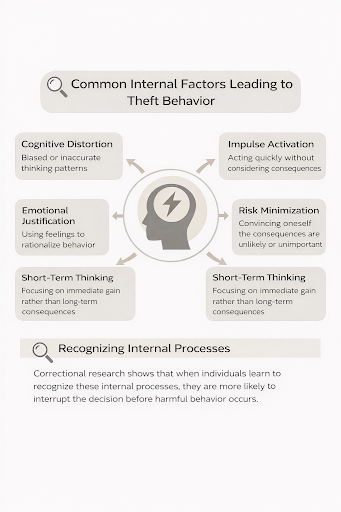
Most legal definitions of theft focus on the external behavior: taking property or services without permission or lawful authorization. Behavioral science focuses on something different — the internal decision process that occurs before the act takes place.
In cognitive behavioral research, theft is rarely a completely spontaneous act.Instead, it usually develops through a predictable sequence of internal steps involving thoughts, emotions, and situational pressures.
Common internal factors that often occur before theft behavior include:
Cognitive Distortion
Biased or inaccurate thinking patterns that distort reality
Impulse Activation
Acting quickly without considering consequences
Emotional Justification
Using feelings to rationalize behavior
Risk Minimization
Convincing oneself the consequences are unlikely or unimportant
Short-Term Thinking
Focusing on immediate gain rather than long-term consequences
Correctional research shows that when individuals learn to recognize these internal processes, they are more likely to interrupt the decision before harmful behavior occurs. Developing this awareness is a key step in reducing repeat behavior and improving decision-making.
Knowledge Check 1 — Theft Prevention Preview
1. Theft behavior is most often:
2. Behavioral intervention programs focus primarily on:
3. Which internal factor involves convincing yourself consequences are unlikely?
Unit 2 — Theft Prevention Preview
Criminal Thinking Errors and Justification Patterns
Criminal thinking errors are automatic thought patterns that distort reality, minimize harm, and justify harmful behavior. These patterns protect the behavior by making it feel acceptable, necessary, or victimless. Recognizing these thinking errors is the foundation of cognitive restructuring.
Thinking Error 1
“They won’t even notice it’s gone.”
Correction
Risk Minimization. Downplaying the likelihood of consequences or the significance of the act. Every theft has a victim and every action has consequences.
Thinking Error 2
“I need it more than they do.”
Correction
Entitlement. Believing personal need justifies taking from others. Need does not create the right to take what belongs to someone else.
Thinking Error 3
“Everybody does it — it’s normal.”
Correction
Normalizing. Assuming the behavior is common or acceptable because others may do it. Other people’s behavior does not reduce your accountability.
Thinking Error 4
“They owed me — I was just getting even.”
Correction
Victim Stance. Framing yourself as the wronged party to justify the act. Taking from others is never a legitimate form of compensation or justice.
Knowledge Check 2 — Theft Prevention Preview
1. Criminal thinking errors are harmless thoughts that don’t affect behavior.
✕ False2. “I need it more than they do” is an example of:
3. Which thinking error involves assuming behavior is acceptable because others do it?
✎ Self-Reflection — Theft Prevention Preview
Which thinking error do you recognize most in your own past decisions? Describe a specific situation where that thinking pattern influenced your behavior and what the consequences were.
25 words minUnit 3 — Theft Prevention Preview
The Decision Chain & Behavioral Risk Meter
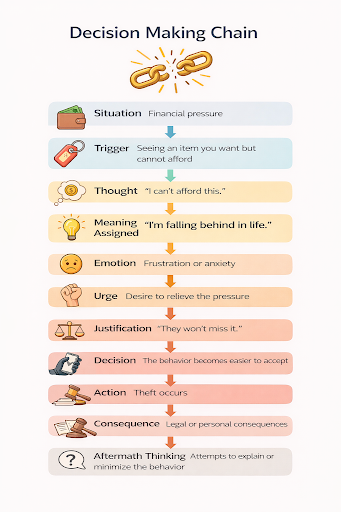
The Decision Chain maps the internal sequence that leads from a triggering situation to harmful behavior. Understanding this chain allows you to identify intervention points — moments where you can interrupt the process before it leads to action.
Trigger → Thought → Emotional Response → Justification → Decision → Action → ConsequenceEvery link in the chain is a point where you can stop, evaluate, and choose differently.
The Behavioral Risk Meter helps you assess where you are on the decision chain at any given moment. It measures your current risk level from High Risk (active justification, impulsive thinking) to Low Risk (structured thinking, consequence-awareness, accountability).
High Risk means you are actively using thinking errors, justifying behavior, and ignoring consequences. Elevated means situational pressures (financial stress, peer influence, emotional triggers) are present and unmanaged. Moderate means you are building awareness of patterns but may still struggle under pressure. Low Risk means you are using structured decision-making, acknowledging consequences, and maintaining accountability.
The goal of this program is to move you from wherever you are now toward Low Risk.By Week 8, you will have the cognitive tools, impulse control strategies, and relapse prevention plan to maintain accountability long-term.
Knowledge Check 3 — Theft Prevention Preview
1. In the Decision Chain, what is the purpose of identifying intervention points?
2. “Elevated” risk on the Behavioral Risk Meter means:
3. True or False: Every link in the Decision Chain is a point where you can choose differently.
✓ True✎ Awareness Exercise — Theft Prevention Preview
Think about a past situation where you made a decision you regret. Map it to the Decision Chain: What was the trigger? What thought followed? What emotion drove the justification? Where could you have interrupted the chain?
25 words minSession 1 Attestation — Theft Prevention Preview
- I understand this is a structured behavioral education program.
- I understand participation and written responses are required for completion.
- I understand I am responsible for confirming this course satisfies my specific court or agency requirement.
Court-Ready Certificate of Completion
Your certificate is issued upon verifiable completion of all program requirements — not upon access alone.
- Participant name
- Program title
- Total instructional hours
- Program duration (8 weeks)
- Date range of participation
- Completion date
- Curriculum summary
- Verification statement
Certificate Disclaimer
- Verifiable and downloadable
- Includes all required documentation
- Issued only after full completion