
8-Week Class (16 Instructional Hours) - $149
An evidence-based CBI curriculum delivered over 8 structured weeks, built to meet court, probation, and diversion requirements.
8 Weeks
16 instructional hours
$149
- 8 structured weekly modules
- Knowledge checks & reflections
- Weekly Decision Tracking
- Court-verifiable certificate
- Scenario-based exercises
Ordered to complete a cognitive skills, decision-making, cognitive-behavioral, or "thinking" class? This online, self-paced course is built for exactly that: court, probation, pretrial-diversion, and deferred-adjudication requirements. It runs 8 weeks (16 hours) for $149, you can start the same day you enroll, and get a court-ready certificate of completion the moment you finish, backed by identity verification and independent confirmation your judge or probation officer can check. The curriculum uses the same evidence base courts rely on, Thinking for a Change (T4C), Moral Reconation Therapy (MRT), Cognitive Behavioral Interventions for Offenders (CBI), and the Risk-Need-Responsivity model, to retrain the thinking errors and impulsive decisions behind the order. If your paperwork names a specific program or provider, confirm with your court or county first, then enroll.
What You’ll Learn Each Week
A progressive, skills-based curriculum grounded in Cognitive-Behavioral Intervention (CBI) principles.
Week 1
Foundations of Thinking and Behavior
Understanding how thoughts influence actions and how decision-making patterns develop.
Week 2
Thinking Errors and Cognitive Distortions
Identifying automatic thoughts, rationalization, blame, and other thinking patterns that lead to poor decisions.
Week 3
Risk Awareness and Consequence Evaluation
Recognizing high-risk situations, short-term vs long-term consequences, and the importance of slowing decisions.
Week 4
Structured Problem-Solving Skills
Learning step-by-step decision models to evaluate options and choose responsible actions.
Week 5
Impulse Control and Emotional Regulation
Managing emotional triggers, delaying reactions, and improving self-control under stress.
Week 6
Perspective Taking and Social Decision Skills
Understanding other viewpoints, improving judgment, and making decisions that reduce conflict.
Week 7
Communication and Conflict Management
Communication styles, listening skills, and strategies for resolving disagreements without escalation.
Week 8
Long-Term Decision Making and Accountability
Relapse prevention, behavioral accountability, and building a personal decision-management plan.
Course Content Preview (Week 1 Sample)
Cognitive Skills Preview · Week 1
Foundations of Thinking and Behavior
CBT Model · Thinking Errors · Decision Meter
Unit 1 — Cognitive Skills Preview
Understanding the Cognitive-Behavioral Model
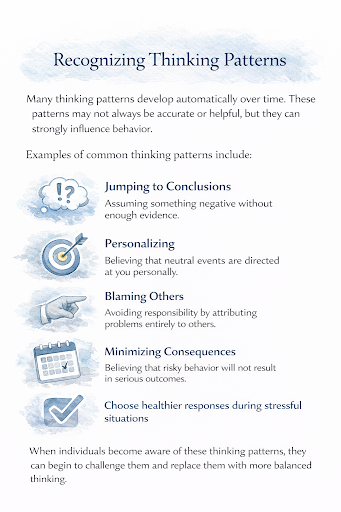
Decision-making is not random. Every choice you make follows a pattern — and that pattern begins with how you think. This program is built on the Cognitive-Behavioral Intervention (CBI) framework, which is widely used in court, probation, diversion, and behavioral accountability programs.
The CBI model teaches that:
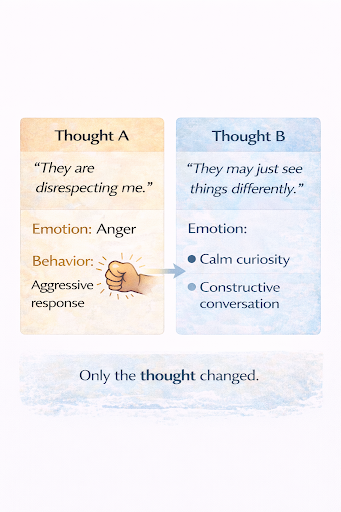
Thoughts → Feelings → Decisions → Consequences
If you change the way you think about a situation, you change the decisions you make. If you change your decisions, you change your outcomes. Most poor decisions are not caused by a lack of intelligence — they are caused by thinking errors, impulsive reactions, and failure to evaluate consequences.
This course integrates principles from evidence-based frameworks including Cognitive Behavioral Interventions for Offenders (CBI), the Risk-Need-Responsivity Model (RNR), Thinking for a Change (T4C), and Moral Reconation Therapy (MRT).
Knowledge Check 1 — Cognitive Skills Preview
1. Which statement best describes the CBI model?
2. Most poor decisions are primarily caused by:
3. Why are you likely taking this course? (Select all that apply)
- Court requirement
- Probation or parole
- Employer requirement
- Personal development
- I don’t actually need to improve my decision-making
Unit 2 — Cognitive Skills Preview
Common Thinking Errors
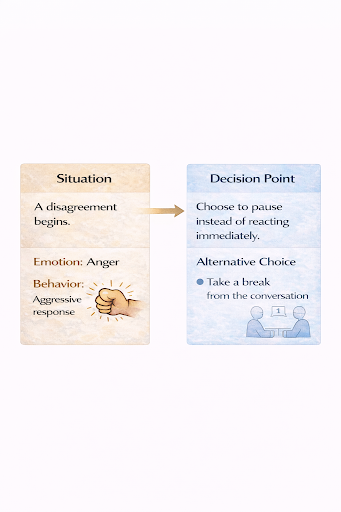
Thinking errors — also called cognitive distortions — are automatic patterns of thought that distort reality, justify poor behavior, and lead to harmful decisions. Recognizing them is the first step to changing them.
The four most common thinking errors that contribute to poor decision-making are:
Thinking Error 1
“It wasn’t my fault.”
Correction
Blaming Others. Shifting responsibility to external causes avoids accountability. Your decisions belong to you regardless of the situation.
Thinking Error 2
“Everyone does it.”
Correction
Minimizing. Normalizing harmful behavior does not reduce its consequences. Other people’s choices do not justify yours.
Thinking Error 3
“I deserve this.”
Correction
Entitlement. Believing rules don’t apply to you leads to poor choices. Accountability means accepting that consequences apply equally.
Thinking Error 4
“It’s not that serious.”
Correction
Rationalizing. Downplaying the impact of your actions prevents you from learning. Every decision has real consequences.
Knowledge Check 2 — Cognitive Skills Preview
1. Thinking errors are harmless habits that don’t affect behavior.
✕ False2. Which of the following is an example of “Blaming Others”?
3. Which thinking error involves normalizing harmful behavior by assuming others do the same?
✎ Self-Reflection — Cognitive Skills Preview
Identify which thinking error you use most often (Blaming / Minimizing / Entitlement / Rationalizing). Describe a specific situation where you used it and what the outcome was.
25 words minUnit 3 — Cognitive Skills Preview
The Decision Meter — Reactive vs. Structured Thinking
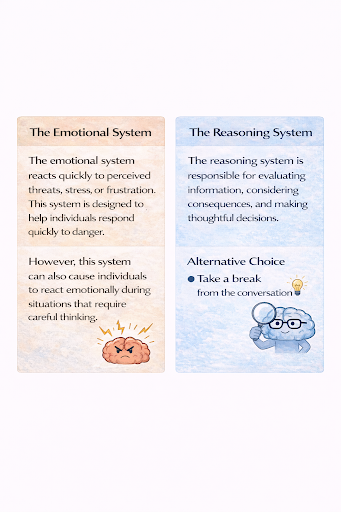
The Decision Meter is a self-assessment tool that helps you recognize how you are making decisions in the moment. It measures your thinking quality on a scale from Reactive (impulsive, emotion-driven) to Structured (deliberate, consequence-aware).
Reactive decisions happen when emotions override thinking — you act before considering consequences. Impulsive decisions follow automatic habits and familiar patterns without evaluation. Cautious decisions begin to slow down the process — you consider options but may still miss long-term impacts. Structured decisions involve deliberate evaluation of options, consequences, and alternatives before acting.
The goal of this program is to move your decision-making from Reactive toward Structured. Most people who enter this program are operating in the Reactive or Impulsive zone. By Week 8, you will have the tools to consistently make Structured decisions.
Knowledge Check 3 — Cognitive Skills Preview
1. A “Reactive” decision is primarily driven by:
2. The goal of this program is to move your decision-making toward which zone?
3. True or False: Most people entering this program are already making Structured decisions.
✕ False✎ Awareness Exercise — Cognitive Skills Preview
Think about a recent decision you made. Where would you place it on the Decision Meter? Reactive / Impulsive / Cautious / Structured? Explain why.
25 words minSession 1 Attestation — Cognitive Skills Preview
- I understand this is a structured behavioral intervention program.
- I understand participation and written responses are required for completion.
- I understand I am responsible for confirming this course satisfies my specific court or agency requirement.
Court-Ready Certificate of Completion
Your certificate is issued upon verifiable completion of all program requirements — not upon access alone.
- Participant name
- Program title
- Total instructional hours
- Duration track (8 weeks)
- Date range of participation
- Curriculum summary
- Verification statement
Certificate Disclaimer
- Verifiable and downloadable
- Includes all required documentation
- Issued only after full completion