
8-Week Program (16 Instructional Hours)
An evidence-based curriculum grounded in CBT, social problem-solving training, and conflict de-escalation frameworks, delivered over 8 structured weeks.
8 Weeks
16 instructional hours
$149
- 8 structured weekly modules
- Knowledge checks & reflections
- Weekly Communication tracking
- Court-verifiable certificate
- Scenario-based exercises
A court, judge, employer, or probation officer can require a conflict resolution and communication skills class after a dispute, a workplace incident, or a low-level interpersonal-conduct matter. It is built for exactly those requirements and runs entirely online at your own pace: complete all 8 weeks (16 instructional hours) for $149, enroll and begin immediately, and download a dated, court-ready certificate of completion as soon as you finish. Every certificate is identity-verified and independently checked, so the court, probation officer, or HR department that ordered the class can confirm it is genuine. The curriculum teaches de-escalation, active listening, assertive communication, and collaborative problem-solving, the skills that keep a disagreement from turning into another charge or a lost job. This is a communication and conflict class, not a state-certified domestic violence or batterer intervention (BIP) program and not the same as anger management, so if your order names DV, BIP, or anger management, confirm the exact requirement first.
What You’ll Learn Each Week
A progressive, skills-based curriculum grounded in Cognitive-Behavioral Therapy (CBT), assertiveness training, and conflict de-escalation frameworks.
Week 1
Understanding Conflict
Why conflict occurs, common sources of disagreement, and how communication patterns influence escalation.
Week 2
Emotional Triggers in Conflict
Recognizing emotional responses that drive escalation and learning trigger awareness.
Week 3
Cognitive Patterns in Conflict
How thoughts influence reactions and restructuring hostile thought patterns.
Week 4
Listening and Understanding
Communication skills that reduce escalation, active listening, and empathic response.
Week 5
Assertive Communication
Expressing needs without aggression, I-statements, and boundary-setting skills.
Week 6
De-Escalation Techniques
Preventing conflict from escalating, timeout strategies, and emotional regulation under pressure.
Week 7
Problem-Solving in Conflict
Collaborative conflict resolution, negotiation, and finding mutually beneficial outcomes.
Week 8
Long-Term Conflict Management
Maintaining behavioral change, relapse prevention, and building a personal communication plan.
Course Content Preview (Week 1 Sample)
Conflict Resolution Preview · Week 1
Understanding Conflict
Introduction · Sources of Conflict · Disagreement vs. Escalation
Unit 1 — Conflict Resolution Preview
Introduction to Conflict Resolution
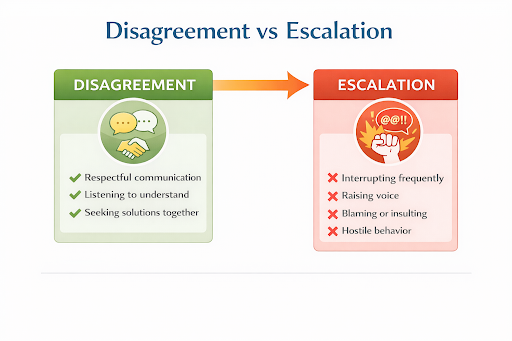
Conflict is a normal part of human interaction. People have different beliefs, expectations, experiences, and perspectives. When these differences collide, disagreements can occur. While conflict itself is not necessarily harmful, the way individuals respond to conflict can determine whether a situation becomes constructive or destructive.
Healthy conflict can lead to problem-solving, improved understanding, and stronger relationships.When people communicate respectfully and listen to each other’s perspectives, disagreements can lead to productive solutions.
However, conflict becomes harmful when communication breaks down and emotions escalate. When individuals feel threatened, disrespected, or misunderstood, they may react defensively or aggressively. These reactions can cause disagreements to intensify and lead to outcomes that are damaging for everyone involved.
Effective conflict resolution involves learning how to manage disagreements without allowing them to escalate into verbal or physical confrontations. This requires several key skills including emotional awareness, active listening, respectful communication, and problem-solving.
This program is grounded in the Cognitive-Behavioral Therapy (CBT) model and integrates principles from established interpersonal skills training, assertiveness training, and conflict de-escalation frameworks.
Knowledge Check 1 — Conflict Resolution Preview
1. Which of the following statements about conflict are true? (Select all that apply)
- Conflict is a normal part of human interaction
- All conflict is harmful and should always be avoided
- Conflict can sometimes lead to problem-solving
- Conflict becomes harmful when communication breaks down
- Effective communication can help resolve disagreements
2. What determines whether conflict becomes constructive or destructive?
3. Effective conflict resolution requires:
Unit 2 — Conflict Resolution Preview
Common Sources of Interpersonal Conflict
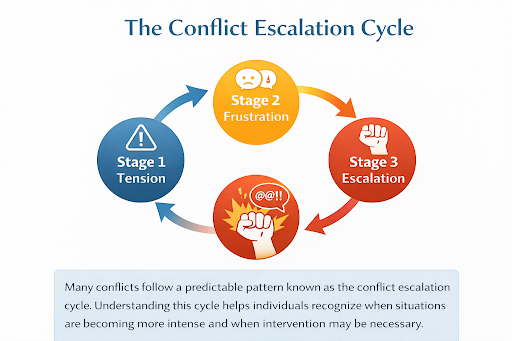
Conflicts often arise because people interpret situations differently or have competing needs and expectations. Many disagreements develop from misunderstandings rather than intentional harm. Understanding the sources of conflict can help individuals recognize that disagreements often result from communication gaps rather than hostility.
Conflict Source
Differences in Expectations
People may have different ideas about how situations should be handled. Two coworkers may disagree about how a task should be completed, or family members may have different expectations about responsibilities.
Conflict Source
Miscommunication
Misunderstandings occur when messages are unclear, incomplete, or interpreted differently than intended. Tone of voice, body language, and word choice can all influence how communication is perceived.
Conflict Source
Stress and External Pressures
Stress from work, financial challenges, or personal responsibilities can increase emotional sensitivity. When people feel overwhelmed, they may react more strongly to minor disagreements.
Conflict Source
Perceived Disrespect
Many conflicts escalate when individuals believe they are being disrespected or ignored. Feeling dismissed or criticized can trigger defensive responses that intensify disagreements.
Conflict Source
Unresolved Past Conflicts
Previous disagreements that were never fully resolved can resurface and contribute to new conflicts. When past issues remain unresolved, individuals may interpret new situations through the lens of previous experiences.
Knowledge Check 2 — Conflict Resolution Preview
1. Most interpersonal conflicts develop from intentional hostility.
✕ False2. When people are under stress, they tend to:
3. Unresolved past conflicts can:
✎ Self-Reflection — Conflict Resolution Preview
Which source of conflict do you encounter most often in your life (Expectations, Miscommunication, Stress, Perceived Disrespect, or Unresolved Past Conflicts)? Describe a specific example and how it escalated.
25 words minUnit 3 — Conflict Resolution Preview
The Difference Between Disagreement and Escalation
Not every disagreement is a conflict, and not every conflict needs to escalate. Understanding the difference between healthy disagreement and harmful escalation is essential for building communication skills that prevent situations from becoming destructive.
Escalation Behaviors
- Raising your voice or yelling
- Name-calling or personal attacks
- Interrupting or talking over the other person
- Bringing up past conflicts to “win”
- Making threats or ultimatums
- Refusing to listen or walking away in anger
Resolution Behaviors
- Speaking calmly and at a measured pace
- Focusing on the issue, not the person
- Listening before responding
- Staying focused on the current issue
- Expressing needs using I-statements
- Taking a timeout when emotions rise
The Communication Response Meter helps you assess how you typically respond during conflict. It measures your communication behavior on a scale from Hostile (aggressive, attacking) to Assertive (respectful, clear, firm).
Hostile communication involves aggression, personal attacks, and intimidation designed to overpower the other person. Defensive communication involves reacting emotionally, guarding your position, and refusing to consider the other perspective. Passive communication involves avoiding conflict entirely, suppressing your needs, and allowing resentment to build. Assertive communication involves expressing your needs clearly and respectfully while remaining open to the other person’s perspective.
The goal of this program is to move your communication from Hostile, Defensive, or Passive toward Assertive.By Week 8, you will have the skills to express yourself clearly, listen actively, de-escalate conflict, and resolve disagreements constructively.
Knowledge Check 3 — Conflict Resolution Preview
1. Which of the following is an escalation behavior?
2. The goal of this program is to move your communication toward which style?
3. True or False: Passive communication is a healthy way to handle conflict.
✕ False✎ Awareness Exercise — Conflict Resolution Preview
Describe a conflict that escalated recently. Where would you place your communication on the Response Meter? Hostile / Defensive / Passive / Assertive? What triggered the escalation, and what could you have done differently?
150 words minSession 1 Attestation — Conflict Resolution Preview
- I understand this is a structured behavioral education program.
- I understand participation and written responses are required for completion.
- I understand I am responsible for confirming this course satisfies my specific court or agency requirement.
Court-Ready Certificate of Completion
Your certificate is issued upon verifiable completion of all program requirements — not upon access alone.
- Participant name
- Program title
- Total instructional hours
- Program duration (8 weeks)
- Date range of participation
- Completion date
- Curriculum summary
- Verification statement
Certificate Disclaimer
- Verifiable and downloadable
- Includes all required documentation
- Issued only after full completion