
Om Worldwide Inc.

COURT-ORDERED ANGER MANAGEMENT PROGRAM

Anger Management Program

A structured Behavioral Health intervention designed to support long-term
behavioral change, self-regulation, and compliance with court,
probation, employer, or agency requirements.

Choose Your Track

Anger Management Program Options

All tracks use the same evidence-based CBT curriculum. Choose the duration that matches your court order or personal goals.

Most Popular

8 Weeks

16 instructional hours

$149

  • 8 structured weekly modules
  • Knowledge checks & reflections
  • Weekly Anger Meter tracking
  • Court-verifiable certificate
  • Scenario-based exercises
Enroll Now — 8 Weeks

12 Weeks

24 instructional hours

$199

  • 12 structured weekly modules
  • Knowledge checks & reflections
  • Weekly Anger Meter tracking
  • Court-verifiable certificate
  • Extended skill practice
Enroll Now — 12 Weeks

16 Weeks

32 instructional hours

$249

  • 16 structured weekly modules
  • Knowledge checks & reflections
  • Weekly Anger Meter tracking
  • Court-verifiable certificate
  • Comprehensive behavioral training
Enroll Now — 16 Weeks
8-Week Curriculum

What You’ll Learn Each Week

A progressive, skills-based curriculum grounded in Cognitive-Behavioral Therapy (CBT).

Week 1

Foundations of Control

Introduction to the CBT model, anger awareness, and course structure.

Week 2

Triggers and High-Risk Situations

Identifying external stressors, warning signs, and escalation patterns.

Week 3

Early Warning Signs

Recognizing physical, emotional, and cognitive cues before loss of control.

Week 4

The Aggression Cycle

Understanding escalation, explosion, and aftermath, and learning timeout skills.

Week 5

Cognitive Restructuring

Using the A-B-C-D model to change thinking patterns and reactions.

Week 6

Communication and Assertiveness

Learning conflict resolution, assertive communication, and emotional control.

Week 7

Personal Anger Management Plan

Building support systems, coping tools, and long-term strategies.

Week 8

Relapse Prevention and Completion

Applying skills to real situations and developing a long-term control plan.

Anger Management Preview Week 1 of 8

Course Content

Anger Management Preview — Week 1 Sample You are viewing Units 1–3 of Week 1 only. Enroll to unlock all 8 weeks, knowledge checks, reflections, and your certificate.

Anger Management Preview · Week 1

Foundations of Control

CBT Model · Myths vs. Facts · Anger Meter

Unit 1 — Anger Management Preview

Understanding the CBT Model

Anger management is not about eliminating anger. Anger is a natural biological emotion. It becomes a problem when it is frequent, intense, leads to aggression, or creates legal, professional, or relational damage.

This course uses the Cognitive Behavioral Therapy (CBT) Model. CBT teaches that:

Thoughts → Feelings → Behaviors

If you change your thinking, you change your emotional reaction. If you change your emotional reaction, you reduce aggressive behavior.

Knowledge Check 1 — Anger Management Preview

1. Which statement best describes CBT?

  • A) Anger is genetic and cannot be changed.
  • B) Thoughts, feelings, and behaviors are connected. ✓
  • C) Anger must be released physically to go away.
  • D) People cannot control emotional reactions.

2. If you change your thoughts about a situation, what changes next?

  • A) Nothing
  • B) The weather
  • C) Your emotional intensity ✓
  • D) Other people’s behavior

3. Why are you likely taking this course? (Select all that apply)

  • Court requirement
  • Employer requirement
  • Relationship conflict
  • Personal growth
  • I don’t actually have an anger issue

Unit 2 — Anger Management Preview

Myths vs. Facts About Anger

Many aggressive behaviors are protected by excuses. We must challenge the four most common myths:

Myth 1

“I was born with a bad temper.”

Fact

Expression of anger is learned behavior. Learned behaviors can be unlearned.

Myth 2

“They pushed me. I had no choice.”

Fact

Anger is internal. Aggression is external. You can be angry without acting aggressively.

Myth 3

“If I’m not aggressive, I’ll get walked on.”

Fact

Assertiveness ≠ Aggression. Assertiveness respects both people.

Myth 4

“Venting helps me get it out.”

Fact

Venting increases nervous system arousal and reinforces aggression.

Knowledge Check 2 — Anger Management Preview

1. Anger automatically leads to aggression.

✕ False

2. Which of the following is Assertive?

  • A) “You better listen to me.”
  • B) “I need to finish speaking before you respond.” ✓
  • C) “You’re disrespecting me.”
  • D) Slamming a door

3. Venting (yelling, hitting objects) typically:

  • A) Calms the nervous system
  • B) Reinforces aggressive patterns ✓
  • C) Solves problems
  • D) Builds respect

✎ Self-Reflection — Anger Management Preview

Select the myth you have used most (Inheritance / No Choice / Power / Venting). Then answer: What do you usually tell yourself before you lose control?

25 words min

Unit 3 — Anger Management Preview

The Anger Meter (1–10 Scale)
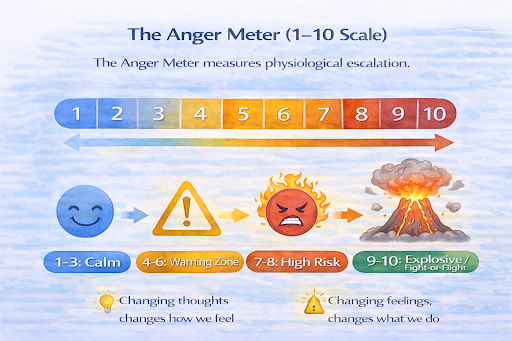
Anger Meter 1-10 Scale Diagram

The Anger Meter measures physiological escalation:

1–3
4–6
7–8
9–10
Calm Warning Zone High Risk Explosive

At Level 10: Rational thinking shuts down, heart rate spikes, impulse control decreases, and risk of arrest or violence increases. The most important level is 5. Intervention must happen before 7.

Knowledge Check 3 — Anger Management Preview

1. At what level is intervention most effective?

  • A) Level 9
  • B) Level 10
  • C) Level 5 ✓
  • D) Level 8

2. At Level 10, the brain is primarily operating in:

  • A) Logic Mode
  • B) Fight-or-Flight Mode ✓
  • C) Calm Reflection Mode
  • D) Problem-Solving Mode

3. True or False: You are most likely to make good decisions at Level 8–10.

✕ False

✎ Awareness Exercise — Anger Management Preview

Level 4 feels like: _______  |  Level 7 feels like: _______  |  Level 10 looks like: _______

Brief phrases only

Session 1 Attestation — Anger Management Preview

  • I understand this is a structured behavioral intervention program.
  • I understand participation and written responses are required for completion.
  • I understand I am responsible for confirming this course satisfies my specific court or agency requirement.
Upon Completion

Court-Ready Certificate of Completion

Your certificate is issued upon verifiable completion of all program requirements — not upon access alone.

  • Participant name
  • Total instructional hours
  • Duration track (8, 12, or 16 weeks)
  • Date range of participation
  • Curriculum summary
  • Verification statement

Certificate Disclaimer

  • Verifiable and downloadable
  • Includes all required documentation
  • Issued only after full completion
  • Not a substitute for legal advice
  • Acceptance determined by the requesting court or agency
  • Not issued for partial completion

12-Week Anger Management Curriculum

Program Preview Week 1 Content

Core Foundation & Foundations of Control

Week 1 Goal: Understand what this program is, why courts/agency programs require it, and learn the core foundation tools: CBT Model, Anger vs. Aggression, and the Anger Meter (1–10 scale).

Full Curriculum Access Weekly tracking logs and verifiable certificates are only available to enrolled students.

Unit 1

Foundations of Control

This is not a passive “read and click” course. It is a structured behavioral intervention designed to reduce aggressive behavior and improve self-regulation.

1A

Welcome to OM Worldwide

Welcome to the OM Worldwide Anger Management Program. Anger is a normal emotion. The goal is not to eliminate anger. The goal is to change what happens when anger rises—especially when it leads to:

  • Yelling, threats, intimidation, or violence
  • Property damage (punching walls, throwing objects)
  • Legal or probation consequences
  • Job loss, program discharge, or family breakdown
  • Shame, guilt, and regret that repeat over time

1B

What Courts & Agencies Care About

Courts and supervising agencies usually focus on behavior, not feelings. They care about:

  • Whether you show up consistently (participation)
  • Whether you demonstrate learning (knowledge checks)
  • Whether you can apply tools (scenarios + written reflection)
  • Whether there is evidence of monitoring over time (logs)

1C

Your Weekly Structure (The “Repeatable System”)

Every week will follow a consistent format. If you treat this like training (like the gym), the skills get easier under pressure:

  • Teach: Learn the core foundation concept.
  • Examples: Review real-world behavioral scenarios.
  • Apply: Connect concepts to your own life and stressors.
  • Test: Verify understanding through knowledge checks.
  • Log: Complete the mandatory weekly log and reflection.

If you treat this like a checkbox, nothing changes. If you treat it like a gym, your responses will change.

Core Tools

CBT Model & Anger vs Aggression

We focus on the CBT Cycle (Thoughts → Feelings → Behaviors) and the critical distinction between emotion (Anger) and behavior (Aggression).

Knowledge Check

1. According to the CBT model, what is the core foundation for changing a reaction?

  • A) Identifying the link between thoughts and actions ✓
  • B) Eliminating the emotion of anger entirely

Self-Monitoring

The Anger Meter (1–10 Scale)

Why self-monitoring matters: It provides the accountability necessary for behavior change. You will track your levels every week to identify escalation patterns before they hit high risk.

1–3
4–6
7–8
9–10
Calm Intervention Zone High Risk Explosive

1D

Program Expectations

To complete Week 1 and the full program, you will be required to:

  • Answer multiple-choice and true/false questions
  • Select required checkboxes for behavioral compliance
  • Write reflections (minimum word counts enforced)
  • Monitor your anger level weekly via the digital log
  • Build a comprehensive Anger Control Plan later in the course

Court-Ready Certification

Upon successful completion of all 12 modules and assignments, you will receive a verifiable certificate that meets national standards.

  • Full participant name & verifiable ID
  • Detailed curriculum summary & 12-week duration
  • Direct digital verification portal for legal agencies

Verification Standards

✓ All 12 Weekly Logs completed

✓ Written Anger Management Plan verified

✓ Final exam & Attestation signed

Frequently Asked Questions

Are these courses accepted by courts and probation?

Yes. OM Worldwide programs are built on structured behavioral education models used in court-ordered, probation, and contracted programs. The same frameworks used in our in-person services are applied to the online courses, which are designed to meet common court and referral requirements. Participants receive a certificate of completion that may be submitted as proof of participation.

Yes. OM Worldwide programs are designed to meet common court, probation, and referral requirements and are based on the same structured behavioral education models used in in-person programs. Our courses are used in multiple states, and participants regularly submit certificates to courts and probation departments. Because requirements can vary by court, county, or agency, you should confirm the required course length and topic if you are unsure.

All courses are fully online and self-paced. There are no live classes and no scheduled sessions. Each program is divided into units that include reading, short quizzes, and written reflections. You may save your work, log in at any time, and complete the course at your own pace.

Most OM Worldwide programs are listed as 8-week courses, with some programs offered in longer formats when required. The course is divided into weekly units, but you may complete the work faster. Once all required units, quizzes, and written reflections are completed, your certificate is issued.

Your certificate shows the course title, program length, instructional hours, and completion date. The program length reflects the course selected and not the amount of time spent online.

Yes. After enrollment, you will receive access right away and may begin the first unit immediately. You can save your work and log back in at your own pace.

Courses can be completed on a computer, tablet, or smartphone with internet access.

Programs teach structured behavioral skills such as emotional regulation, decision-making, communication skills, stress control, and personal responsibility using cognitive-behavioral education models. The course is designed to be clear and easy to follow, and no special experience or education is required.

You may review the lesson and try again. The quizzes are part of the learning process, and participants are able to continue after reviewing the material. Your information is kept confidential and used only for course records and certificate generation.

Because course access is provided immediately after enrollment, all sales are final. Please make sure you select the correct course and length before enrolling. If you are unsure which program you need, contact OM Worldwide before purchase.