Train the Skills That Shape Your Life
Behavioral education teaches fundamental human skills: emotional regulation, cognitive awareness, impulse control, decision-making, communication, and conflict resolution.
These skills influence how we lead, work, parent, build relationships, handle pressure, and respond when emotions run high-yet most of us were never formally taught them.
OM Worldwide brings curriculum currently used in government and court-referred settings into accessible, self-paced online courses-giving anyone the opportunity to develop these skills proactively and put them to work in everyday life.
- Standards-Based
- Locked Weekly Progression
- 24/7 Mobile Access
- Licensed Clinician Oversight
- Court-Verifiable Certificates
Why People Choose OM WorldWide
Evidence-informed:
Curriculum grounded in cognitive-behavioral principles.
Certificate of completion:
For every course you finish.for every course you finish.
100% online and fully:
Self-paced on any device.
Built by a team that delivers:
Behavioral education inside government and rehabilitation settings.
Structured, Evidence-Based Behavioral Skills Training
These aren’t motivational videos or quick tips. OM Worldwide programs use structured learning, repetition, reflection and real-world application to help you recognize patterns and practice better responses.
Our behavioral education programs draw from established frameworks including Cognitive Behavioral Therapy (CBT) principles, and our Anger Management curriculum incorporates concepts derived from clinical protocols developed for the U.S. Substance Abuse and Mental Health Services Administration (SAMHSA). The same kind of structured skills education used in rehabilitation and government-serving environments can be valuable long before anyone is required to take it.
| Program | Duration | Price | Hours | |
|---|---|---|---|---|
| Anger Management | 8 Weeks | $149 | 16 hrs | Enroll Now Details |
| Life Skills Readiness | 8 Weeks | $149 | 16 hrs | Enroll Now Details |
| Active Parenting & Family Skills | 8 Weeks | $149 | 16 hrs | Enroll Now Details |
| Cognitive Skills & Decision Making | 8 Weeks | $149 | 16 hrs | Enroll Now Details |
| Conflict Resolution & Communication Skills | 8 Weeks | $149 | 16 hrs | Enroll Now Details |
How Does Enrollment Work?

Enroll & Start Immediately
Create your account and start immediately, self-paced.

Finish & Get Your Certificate
Complete the lessons and download your certificate of completion.

Program Details & Syllabus
Tap any program to view what’s included and enrollment options.
Anger Management
Control emotional reactions and respond to conflict calmly
8, 12, or 16 Weeks · from $149 · 16 Instructional HoursGrounded in Cognitive-Behavioral Therapy (CBT), the program focuses on emotional awareness, decision-making, and practical strategies for managing anger and conflict in everyday situations.
Courts, probation departments, diversion programs, employers, and reentry agencies commonly order anger management education. Also appropriate for individuals seeking to improve emotional regulation and communication.
View Program →
Life Skills Readiness
Reentry planning, accountability, and community integration
8 Weeks · $149 · 16 Instructional HoursA structured behavioral education course designed to support reentry, personal accountability, and successful community reintegration. Built on the same evidence-based curriculum used in our in-person correctional programs.
Courts, probation departments, reentry programs, halfway houses, and diversion programs. Commonly ordered for individuals transitioning from incarceration into community settings.
View Program →
Active Parenting & Family Skills
Evidence-based parenting for justice-involved caregivers
8 Weeks · $149 · 16 Instructional HoursA structured behavioral education course for parents and caregivers involved with the justice system. Built on evidence-based parenting principles.
Family courts, child welfare agencies, probation departments, and diversion programs. Commonly ordered for parents involved in child custody proceedings or child protective services cases.
View Program →
Cognitive Skills & Decision Making
Thought patterns, criminal thinking, and prosocial decision-making
8 Weeks · $149 · 16 Instructional HoursAddresses the thought processes, attitudes, and beliefs that contribute to poor decision-making and recidivism. Grounded in Cognitive-Behavioral Intervention (CBI) principles.
Courts, probation departments, and reentry programs. Commonly ordered for individuals with repeat offenses, criminal thinking patterns, or as part of a structured reentry or diversion plan.
View Program →
Conflict Resolution & Communication Skills
De-escalation, assertiveness, and effective communication strategies
8 Weeks · $149 · 16 Instructional HoursA structured behavioral education course grounded in evidence-based communication and conflict resolution principles. Focuses on de-escalation techniques, assertive communication, and practical strategies for resolving interpersonal disputes without aggression or coercion.
Courts, probation departments, diversion programs, employers, and reentry agencies. Commonly ordered for individuals whose offenses involved interpersonal conflict, workplace disputes, or communication-related behavioral issues.
View Program →
Course Content Preview (Week 1 Sample)
Anger Management Preview · Week 1
Foundations of Control
CBT Model · Myths vs. Facts · Anger Meter
Unit 1 — Anger Management Preview
Understanding the CBT Model
Anger management is not about eliminating anger. Anger is a natural biological emotion. It becomes a problem when it is frequent, intense, leads to aggression, or creates legal, professional, or relational damage.
This course uses the Cognitive Behavioral Therapy (CBT) Model. CBT teaches that:
Thoughts → Feelings → Behaviors
If you change your thinking, you change your emotional reaction. If you change your emotional reaction, you reduce aggressive behavior.
Knowledge Check 1 — Anger Management Preview
1. Which statement best describes CBT?
- A) Anger is genetic and cannot be changed.
- B) Thoughts, feelings, and behaviors are connected. ✓
- C) Anger must be released physically to go away.
- D) People cannot control emotional reactions.
2. If you change your thoughts about a situation, what changes next?
- A) Nothing
- B) The weather
- C) Your emotional intensity ✓
- D) Other people’s behavior
3. Why are you likely taking this course? (Select all that apply)
- Court requirement
- Employer requirement
- Relationship conflict
- Personal growth
- I don’t actually have an anger issue
Unit 2 — Anger Management Preview
Myths vs. Facts About Anger
Many aggressive behaviors are protected by excuses. We must challenge the four most common myths:
Myth 1
“I was born with a bad temper.”
Fact
Expression of anger is learned behavior. Learned behaviors can be unlearned.
Myth 2
“They pushed me. I had no choice.”
Fact
Anger is internal. Aggression is external. You can be angry without acting aggressively.
Myth 3
“If I’m not aggressive, I’ll get walked on.”
Fact
Assertiveness ≠ Aggression. Assertiveness respects both people.
Myth 4
“Venting helps me get it out.”
Fact
Venting increases nervous system arousal and reinforces aggression.
Knowledge Check 2 — Anger Management Preview
1. Anger automatically leads to aggression.
✕ False2. Which of the following is Assertive?
- A) “You better listen to me.”
- B) “I need to finish speaking before you respond.” ✓
- C) “You’re disrespecting me.”
- D) Slamming a door
3. Venting (yelling, hitting objects) typically:
- A) Calms the nervous system
- B) Reinforces aggressive patterns ✓
- C) Solves problems
- D) Builds respect
✎ Self-Reflection — Anger Management Preview
Select the myth you have used most (Inheritance / No Choice / Power / Venting). Then answer: What do you usually tell yourself before you lose control?
25 words minUnit 3 — Anger Management Preview
The Anger Meter (1–10 Scale)
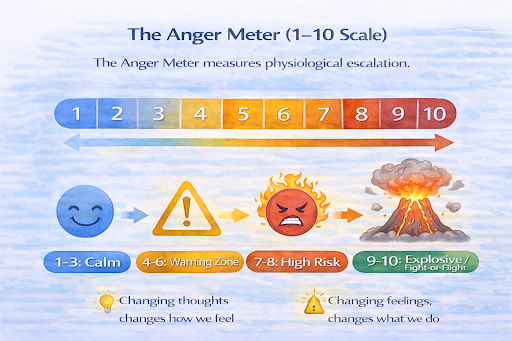
The Anger Meter measures physiological escalation:
At Level 10: Rational thinking shuts down, heart rate spikes, impulse control decreases, and risk of arrest or violence increases. The most important level is 5. Intervention must happen before 7.
Knowledge Check 3 — Anger Management Preview
1. At what level is intervention most effective?
- A) Level 9
- B) Level 10
- C) Level 5 ✓
- D) Level 8
2. At Level 10, the brain is primarily operating in:
- A) Logic Mode
- B) Fight-or-Flight Mode ✓
- C) Calm Reflection Mode
- D) Problem-Solving Mode
3. True or False: You are most likely to make good decisions at Level 8–10.
✕ False✎ Awareness Exercise — Anger Management Preview
Level 4 feels like: _______ | Level 7 feels like: _______ | Level 10 looks like: _______
Brief phrases onlySession 1 Attestation — Anger Management Preview
- I understand this is a structured behavioral intervention program.
- I understand participation and written responses are required for completion.
- I understand I am responsible for confirming this course satisfies my specific court or agency requirement.
Program Requirements & Completion Standards
Every program is structured to meet court and agency accountability expectations — not just lesson viewing.
Identity attestation required at enrollment
Sequential course progression required
Knowledge checks required throughout the program
Written reflections required in each weekly unit
Completion verified prior to certificate issuance
Programs require minimum participation time based on court standards
Certificates issued only after all program requirements are completed
Do You Get a Certificate?
Yes. Every OM Worldwide course ends with a certificate of completion showing your name, the course, the instructional hours and the completion date. You can download it the moment you finish and keep it for your own records, employer or personal goals.
- Participant name
- Course title and program length
- Total instructional hours
- Completion date and certificate ID
- Download immediately upon completion
- Submit directly to your court or attorney
- Provide to your probation officer
- Keep a copy for your personal records
Acceptance of a certificate is determined by the requesting court, employer, or agency. Confirm your requirements before enrolling.
Start Building Your Skills Today
Launch offer: first course 50% off — $74.50 (regularly $149).
Enroll Now →Self-paced, start immediately, certificate included.
Frequently Asked Questions
Why would I take a course that is also used for court-ordered education?
Because the skills aren’t “court skills.” They’re human skills.
Emotional regulation, communication, conflict resolution, decision-making, impulse control, cognitive awareness, and personal responsibility affect how we lead, work, parent, build relationships, and respond under pressure.
These skills are often taught after someone is required to address them. OM Worldwide believes there is value in learning them before they become a problem.
Are these the same types of courses used in court-referred and correctional settings?
Yes. OM Worldwide’s Personal Development offering grew out of our work providing structured behavioral education for court-referred, correctional, rehabilitation, and government-serving environments.
We’ve made this education available for voluntary personal development because the underlying skills are relevant far beyond required settings.
What makes these different from typical online self-improvement courses?
These aren’t motivational talks, life hacks, or content designed simply to make you feel inspired for an afternoon.
Our programs use structured lessons, practical exercises, reflection, knowledge checks, and repetition to help you understand your own patterns and practice different responses.
The goal isn’t just to hear good advice. It’s to learn skills you can continue applying in real situations.
Are these courses evidence-based?
Our curricula draw from established behavioral and cognitive-behavioral principles. For example, OM Worldwide’s Anger Management curriculum incorporates concepts derived from SAMHSA clinical protocols and teaches skills including identifying triggers and cues, cognitive restructuring, emotional regulation, impulse control, communication, and relapse prevention.
We describe our programs as evidence-informed behavioral education rather than claiming that an OM course itself is clinical treatment.
Why wasn't I taught this in school?
Traditional education teaches academic and professional knowledge, but many adults receive little formal instruction in how to recognize emotional triggers, challenge automatic thinking, communicate during conflict, regulate reactions, or make thoughtful decisions under pressure.
Yet we use these skills every day.
You can train for your career. You can train your body. You can train behavioral skills, too.
Who actually benefits from learning these skills?
You don’t need to have an “anger problem” or be struggling in life.
These skills can be useful for a business owner managing employees, a leader navigating difficult conversations, a salesperson handling pressure and rejection, a parent responding during stressful moments, a couple working through disagreements, or anyone interested in understanding their own reactions and decisions more clearly.
Personal development doesn’t have to begin because something is wrong.
Isn't this just common sense?
Some of the concepts may sound simple once you learn them. Applying them consistently—especially when you’re stressed, angry, defensive, overwhelmed, or under pressure—is different.
Recognizing a trigger is one thing. Recognizing it while you’re being triggered and choosing a different response is a skill.
That’s why the courses emphasize learning, reflection, application, and repetition.
Is this therapy?
No. OM Worldwide courses are educational programs, not therapy, counseling, diagnosis, or mental health treatment.
They teach structured behavioral skills that can be practiced independently and can also complement other forms of personal or professional development.
What can I expect to learn?
Depending on the course you choose, topics include emotional regulation, trigger awareness, impulse control, cognitive patterns, decision-making, communication, conflict resolution, problem-solving, parenting, boundaries, personal responsibility, and other practical life skills.
You can choose the area most relevant to what you want to strengthen.
Which course should I start with?
If you want to better understand your emotional reactions, triggers, and self-control, start with Emotional Regulation & Anger Management.
For broader everyday development, choose Essential Life Skills. For thinking patterns and choices, choose Cognitive Skills & Decision Making. For difficult conversations and disagreements, choose Conflict Resolution & Communication Skills. For family relationships, choose Active Parenting & Family Skills.
Do I need a court order or referral to enroll?
Not at all. These programs are available to anyone who wants to take them voluntarily for personal development.
No referral, court order, or special eligibility is required.
How does the course work?
Courses are 100% online and self-paced. You work through structured lessons and activities on your own schedule and receive a certificate after successful completion.
Can I go back through the material again?
You can revisit course material during your course-access period, making it easier to reinforce concepts rather than treating the program as something you complete once and immediately forget.
Behavioral skills, like physical skills, become more useful when they’re practiced and reinforced.
Why should I spend $149 on this when I can read a self-help book or watch videos online?
Books, podcasts, and videos can be valuable sources of information. A structured course serves a different purpose.
OM Worldwide organizes behavioral concepts into a guided learning experience with lessons, exercises, reflection, and knowledge checks designed to move you from simply consuming information to actively working through it.
Personal development shouldn’t just be something you read about. Learn it. Practice it. Apply it.