
Choose Your Program: 8, 12, or 16 Weeks
All tracks use the same evidence-based CBT curriculum. Choose the duration that matches your court order or personal goals.
8 Weeks
16 instructional hours
$149
- 8 structured weekly modules
- Knowledge checks & reflections
- Weekly Anger Meter tracking
- Court-verifiable certificate
- Scenario-based exercises
12 Weeks
24 instructional hours
$199
- 12 structured weekly modules
- Knowledge checks & reflections
- Weekly Anger Meter tracking
- Court-verifiable certificate
- Extended skill practice
16 Weeks
32 instructional hours
$249
- 16 structured weekly modules
- Knowledge checks & reflections
- Weekly Anger Meter tracking
- Court-verifiable certificate
- Comprehensive behavioral training
OM Worldwide's court-approved anger management classes are online, self-paced, and built for court, probation, judge, employer, or agency requirements. Choose the length your order requires: 8 weeks (16 instructional hours) for $149, 12 weeks (24 hours) for $199, or 16 weeks (32 hours) for $249. A court-verifiable certificate of completion is issued after you finish all required modules, knowledge checks, written reflections, and completion verification. Acceptance is decided by your specific court or agency, so confirm the required length if your order is unclear, then enroll and start today.
What You’ll Learn Each Week
A progressive, skills-based curriculum grounded in Cognitive-Behavioral Therapy (CBT).
Week 1
Foundations of Control
Introduction to the CBT model, anger awareness, and course structure.
Week 2
Triggers and High-Risk Situations
Identifying external stressors, warning signs, and escalation patterns.
Week 3
Early Warning Signs
Recognizing physical, emotional, and cognitive cues before loss of control.
Week 4
The Aggression Cycle
Understanding escalation, explosion, and aftermath, and learning timeout skills.
Week 5
Cognitive Restructuring
Using the A-B-C-D model to change thinking patterns and reactions.
Week 6
Communication and Assertiveness
Learning conflict resolution, assertive communication, and emotional control.
Week 7
Personal Anger Management Plan
Building support systems, coping tools, and long-term strategies.
Week 8
Relapse Prevention and Completion
Applying skills to real situations and developing a long-term control plan.
Course Content Preview (Week 1 Sample)
Anger Management Preview · Week 1
Foundations of Control
CBT Model · Myths vs. Facts · Anger Meter
Unit 1 — Anger Management Preview
Understanding the CBT Model
Anger management is not about eliminating anger. Anger is a natural biological emotion. It becomes a problem when it is frequent, intense, leads to aggression, or creates legal, professional, or relational damage.
This course uses the Cognitive Behavioral Therapy (CBT) Model. CBT teaches that:
Thoughts → Feelings → Behaviors
If you change your thinking, you change your emotional reaction. If you change your emotional reaction, you reduce aggressive behavior.
Knowledge Check 1 — Anger Management Preview
1. Which statement best describes CBT?
2. If you change your thoughts about a situation, what changes next?
3. Why are you likely taking this course? (Select all that apply)
- Court requirement
- Employer requirement
- Relationship conflict
- Personal growth
- I don’t actually have an anger issue
Unit 2 — Anger Management Preview
Myths vs. Facts About Anger
Many aggressive behaviors are protected by excuses. We must challenge the four most common myths:
Myth 1
“I was born with a bad temper.”
Fact
Expression of anger is learned behavior. Learned behaviors can be unlearned.
Myth 2
“They pushed me. I had no choice.”
Fact
Anger is internal. Aggression is external. You can be angry without acting aggressively.
Myth 3
“If I’m not aggressive, I’ll get walked on.”
Fact
Assertiveness ≠ Aggression. Assertiveness respects both people.
Myth 4
“Venting helps me get it out.”
Fact
Venting increases nervous system arousal and reinforces aggression.
Knowledge Check 2 — Anger Management Preview
1. Anger automatically leads to aggression.
✕ False2. Which of the following is Assertive?
3. Venting (yelling, hitting objects) typically:
✎ Self-Reflection — Anger Management Preview
Select the myth you have used most (Inheritance / No Choice / Power / Venting). Then answer: What do you usually tell yourself before you lose control?
25 words minUnit 3 — Anger Management Preview
The Anger Meter (1–10 Scale)
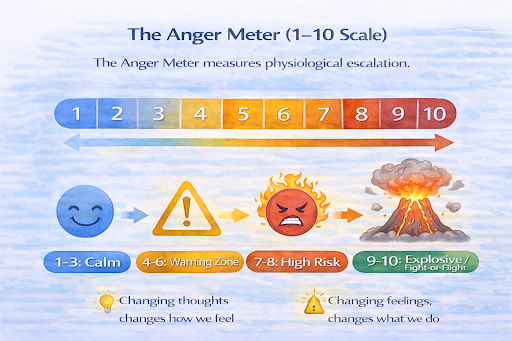
The Anger Meter measures physiological escalation:
At Level 10: Rational thinking shuts down, heart rate spikes, impulse control decreases, and risk of arrest or violence increases. The most important level is 5. Intervention must happen before 7.
Knowledge Check 3 — Anger Management Preview
1. At what level is intervention most effective?
2. At Level 10, the brain is primarily operating in:
3. True or False: You are most likely to make good decisions at Level 8–10.
✕ False✎ Awareness Exercise — Anger Management Preview
Level 4 feels like: _______ | Level 7 feels like: _______ | Level 10 looks like: _______
Brief phrases onlySession 1 Attestation — Anger Management Preview
- I understand this is a structured behavioral intervention program.
- I understand participation and written responses are required for completion.
- I understand I am responsible for confirming this course satisfies my specific court or agency requirement.
Court-Ready Certificate of Completion
Your certificate is issued upon verifiable completion of all program requirements — not upon access alone.
- Participant name
- Total instructional hours
- Duration track (8, 12, or 16 weeks)
- Date range of participation
- Curriculum summary
- Verification statement
Certificate Disclaimer
- Verifiable and downloadable
- Includes all required documentation
- Issued only after full completion