
8-Week Program (16 Instructional Hours)
An evidence-based curriculum grounded in CBT, the Duluth Model, and behavioral accountability frameworks, delivered over 8 structured weeks.
8 Weeks
16 instructional hours
$149
- 8 structured weekly modules
- Knowledge checks & reflections
- Weekly Behavioral Awareness tracking
- Court-verifiable certificate
- Scenario-based exercises
OM Worldwide's online Domestic Violence Prevention Education class is a court-ordered, 100% online, self-paced program offered as an 8-week course (16 instructional hours) for $149, with a court-ready certificate of completion issued instantly when you finish. It is accepted for many court, county, probation, protective-order, diversion, family court, and attorney-instructed DV education requirements nationwide, and every completion is identity-verified and independently confirmed so a judge or probation officer can trust it. Court acceptance for domestic violence is stricter than for anger management: if your case is a criminal DV conviction in a state that mandates a certified Batterers Intervention Program (BIP), confirm with your court or probation officer before enrolling, because a general online DV education class may not satisfy a BIP requirement. The fastest way to be certain is to ask your court, county, or PO whether they accept an online domestic violence prevention class, then enroll today and start immediately.
What You’ll Learn Each Week
A progressive, skills-based curriculum grounded in CBT, the Duluth Power and Control Model, and behavioral accountability frameworks.
Week 1
Understanding Domestic Conflict and Relationship Behavior
Definitions of domestic violence, unhealthy relationship patterns, and how harmful behaviors develop over time.
Week 2
Power and Control Dynamics
Recognizing controlling behaviors, emotional manipulation, intimidation, and the Power and Control model.
Week 3
The Cycle of Abuse
Understanding tension building, conflict incidents, reconciliation, and repeating relationship patterns.
Week 4
Emotional Triggers and Escalation
Identifying anger, jealousy, stress, and rejection triggers, and learning emotional regulation strategies.
Week 5
Accountability and Personal Responsibility
Accepting responsibility for behavior, avoiding blame shifting, and understanding consequences of harmful actions.
Week 6
Impact on Partners, Children, and Family Stability
How conflict affects emotional safety, trust, and long-term family relationships.
Week 7
Healthy Communication Skills
Active listening, respectful expression, conflict de-escalation, and assertive but non-aggressive communication.
Week 8
Building Respectful and Healthy Relationships
Developing trust, equality, emotional safety, and long-term relationship stability.
Course Content Preview (Week 1 Sample)
DV Awareness Preview · Week 1
Understanding Domestic Violence
CBT Framework · Behavior Patterns · Relationship Awareness Meter
Unit 1 — DV Awareness Preview
Understanding Domestic Violence
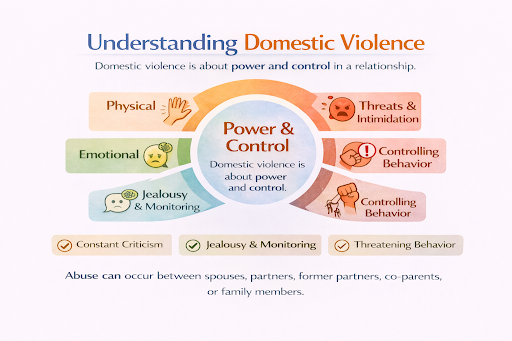
Domestic violence is often misunderstood. Many people believe it only refers to physical violence such as hitting or pushing. While physical violence is one form of abuse, domestic violence can also include emotional harm, intimidation, threats, and controlling behavior.
Domestic violence is defined as a pattern of behavior used to gain or maintain power and control in a relationship.
These behaviors may occur between spouses or partners, people who are dating, former partners, co-parents, or family members living in the same household.
Abuse rarely begins with extreme violence. It often begins with subtle forms of control, criticism, or emotional pressure. Over time these behaviors may escalate. Examples include constant criticism or insults, jealousy that leads to monitoring a partner’s activities, threatening behavior during arguments, controlling finances or decisions, and intimidation or aggressive communication.
Conflict itself is not abuse.All relationships experience disagreements. However, when one person repeatedly uses intimidation, control, or fear to influence the other person, the relationship becomes unsafe. Understanding the difference between healthy conflict and harmful behavior patterns is the first step toward change.
This program is grounded in Cognitive Behavioral Therapy (CBT) principles. CBT focuses on the relationship between thoughts, emotions, and actions — helping individuals recognize patterns and develop healthier responses to conflict.
Knowledge Check 1 — DV Awareness Preview
1. Domestic violence is best described as:
2. Which of the following behaviors can appear in unhealthy relationships? (Select all that apply)
- Constant criticism
- Monitoring a partner’s activities
- Respectful disagreement
- Threats during arguments
3. Abuse typically begins with:
Unit 2 — DV Awareness Preview
Harmful Patterns vs. Healthy Relationship Behavior
Many harmful relationship behaviors are protected by excuses, minimization, or denial. Recognizing the difference between harmful patterns and healthy alternatives is essential for building accountability and changing behavior.
Harmful Pattern
“I only yelled because they pushed me to it.”
Healthy Alternative
Accountability. Your reaction is your responsibility regardless of what the other person did. Blaming your partner for your behavior is a control tactic.
Harmful Pattern
“I check their phone because I care.”
Healthy Alternative
Trust and respect. Monitoring a partner’s communications, location, or social interactions is controlling behavior, not care. Trust is built through openness, not surveillance.
Harmful Pattern
“It wasn’t that serious — nobody got hurt.”
Healthy Alternative
Impact awareness. Emotional harm, intimidation, and fear cause lasting damage even without physical contact. Minimizing harm prevents accountability.
Harmful Pattern
“I’m the one who makes the decisions here.”
Healthy Alternative
Equality and shared decision-making. Healthy relationships involve mutual input, compromise, and respect for both partners’ perspectives.
Knowledge Check 2 — DV Awareness Preview
1. Blaming a partner for your reaction is a form of accountability.
✕ False2. Monitoring a partner’s phone and social media is:
3. Emotional harm and intimidation can cause lasting damage even without physical contact.
✓ True✎ Self-Reflection — DV Awareness Preview
Which harmful pattern do you recognize most in your own past behavior or relationships? How did it affect the other person? What would the healthy alternative have looked like?
25 words minUnit 3 — DV Awareness Preview
The Relationship Awareness Meter
The Relationship Awareness Meter is a self-assessment tool that helps you recognize where your relationship behaviors fall on a scale from Harmful (controlling, fear-based) to Healthy (respectful, equal, safe).
Harmful behaviors involve using power, control, intimidation, or fear to influence a partner’s actions. At-Risk behaviors include escalation patterns such as raising your voice, making threats during arguments, or using jealousy to justify monitoring. Aware behaviors indicate you are beginning to recognize harmful patterns and are building accountability, but may still fall back on old responses under stress. Healthy behaviors involve mutual respect, shared decision-making, emotional safety, and consistent accountability.
The goal of this program is to move your relationship behaviors from Harmful or At-Risk toward Healthy.By Week 8, you will have the awareness, accountability tools, and communication skills to build respectful and safe relationships.
Knowledge Check 3 — DV Awareness Preview
1. “At-Risk” relationship behavior includes:
2. The goal of this program is to move your relationship behaviors toward which zone?
3. True or False: Healthy relationships never have disagreements.
✕ False✎ Awareness Exercise — DV Awareness Preview
Think about your most recent conflict with a partner, co-parent, or family member. Where would you place your behavior on the Relationship Awareness Meter? Harmful / At-Risk / Aware / Healthy? Explain why.
25 words minSession 1 Attestation — DV Awareness Preview
- I understand this is a structured behavioral education program.
- I understand participation and written responses are required for completion.
- I understand this program is not a state-certified Batterer’s Intervention Program (BIP).
- I understand I am responsible for confirming this course satisfies my specific court or agency requirement.
Court-Ready Certificate of Completion
Your certificate is issued upon verifiable completion of all program requirements — not upon access alone.
- Participant name
- Program title
- Total instructional hours
- Program duration (8 weeks)
- Date range of participation
- Completion date
- Curriculum summary
- Verification statement
Certificate Disclaimer
- Verifiable and downloadable
- Includes all required documentation
- Issued only after full completion